Wagering Requirement Meaning: Complete 2026 Bonus Terms Explained
The wagering requirement meaning is straightforward once you stop reading a wallet screen as a single number: a wagering requirement is a condition attached to credited bonus funds saying those funds must be staked a set number of times before any part of them, or the winnings they produce, can be requested as a withdrawal. Most of the frustration people describe — a balance that shows ₹1,200 but refuses to release ₹200 — is not a broken app and not a vanished payment.
It is a bonus balance sitting behind a turnover condition that was agreed to at the moment the credit was accepted. This breakdown defines the term, shows the arithmetic with worked examples, and points to where the conditions are written down, so the number on screen and the number you can actually move stop being a surprise. Nothing here recommends any platform, bonus or offer. 18+ only, real-money play carries risk, and losses are the expected outcome over time.
Wagering Requirement Meaning In Plain English
In simple terms, the wagering requirement meaning comes down to one sentence: the bonus is not yours yet, it is held against activity. An app credits an amount into your account, and in exchange it attaches a rule saying that amount has to pass through staking a certain number of times before it converts into funds you can take out. Until that volume of staking has happened, the credited amount behaves like a token inside the account rather than like money in a bank balance.
The condition is almost always expressed as a multiplier against the bonus value — written as 10x, 20x, 40x, or sometimes “turnover” or “rollover”. Those three words mean the same thing in practice. Turnover is the total value of stakes placed, not the total amount won or lost. A player who stakes ₹100 twenty separate times has generated ₹2,000 of turnover even if the balance barely moved, because turnover counts the stakes, not the outcome.
This is why the term confuses people so reliably. A withdrawal screen talks about money. A bonus condition talks about activity. The two units never look alike, and an app that shows them in the same wallet total with no separating label invites exactly the complaint that follows: the user believes they are owed a figure the system never treated as owed.
It also helps to notice what the condition is not. It is not a fee, because nothing is deducted from your own cash when a bonus locks. It is not a processing delay, because no amount of waiting advances it — only staking does. And it is not a penalty applied to you individually; the same multiplier normally applies to every account that accepted the same credit. Separating those three ideas removes most of the mystery before any arithmetic starts.
There is a reason the condition exists at all, and it is worth stating plainly rather than darkly. Credited funds with no condition could be deposited, credited and immediately withdrawn without any play, which turns a promotion into a cash giveaway. The wagering condition is the mechanism that prevents that. Understanding it is not about finding a loophole — it is about knowing in advance whether a credit is worth anything to you, because very often the honest answer is that it is not.
Bonus Balance vs Cash Balance: Two Numbers, One Screen
Almost every gaming app keeps at least two internal balances and then, unhelpfully, displays their sum. The cash balance holds money you transferred in yourself plus anything already released from conditions. The bonus balance holds credited amounts still carrying turnover conditions. Some apps add a third bucket for winnings generated while a bonus is active, which may itself be locked until the condition clears.
Wallet balance is therefore the total the interface chooses to show. Withdrawable balance is the subset the payment system will let you move. The gap between them is not an error and it is not a fee. It is the sum of everything still under condition, and on a well-built app you can see the split by tapping into the wallet detail or transaction history rather than reading only the headline figure.
| Term on screen | What it usually contains | Can you withdraw it |
|---|---|---|
| Total balance / wallet | Cash plus bonus plus locked winnings | Only the cash portion |
| Cash / main balance | Your deposits and released funds | Normally yes |
| Bonus / promo balance | Credited funds under turnover conditions | No, until conditions are met |
| Locked or pending winnings | Winnings produced while a bonus was active | Depends on the stated terms |
| Withdrawable balance | The figure the payout system will accept | Yes, this is the real number |
Which bucket a stake is drawn from matters as much as the labels, and the order is set by the terms rather than by you. Some systems spend cash first and only touch bonus funds once cash is exhausted, which keeps your own deposit reachable for longer. Others spend bonus funds first, or draw proportionally from both. The practical effect is that two accounts with identical totals can be in completely different positions after the same number of stakes, purely because of deduction order.
Transaction history is usually more honest than the wallet header, because each line is labelled by type. Deposits appear as transfers in, credits appear as bonus or promo entries, and conversions from locked to released funds often appear as a separate adjustment line when a condition completes. Reading those labels in order tells you exactly how much of the current total arrived as your own money, which is the only part a payout request can rely on.
The practical habit is to stop reading the big number entirely and find the withdrawable figure instead. If an app does not expose one, treat the transaction history as the source of truth. When a payout does not move at all despite a clear cash balance, that is a different problem with different causes, and the walkthrough on why a withdrawal can sit in a pending state for days covers the verification and processing side of it.
How 10x, 20x And 40x Turnover Is Calculated
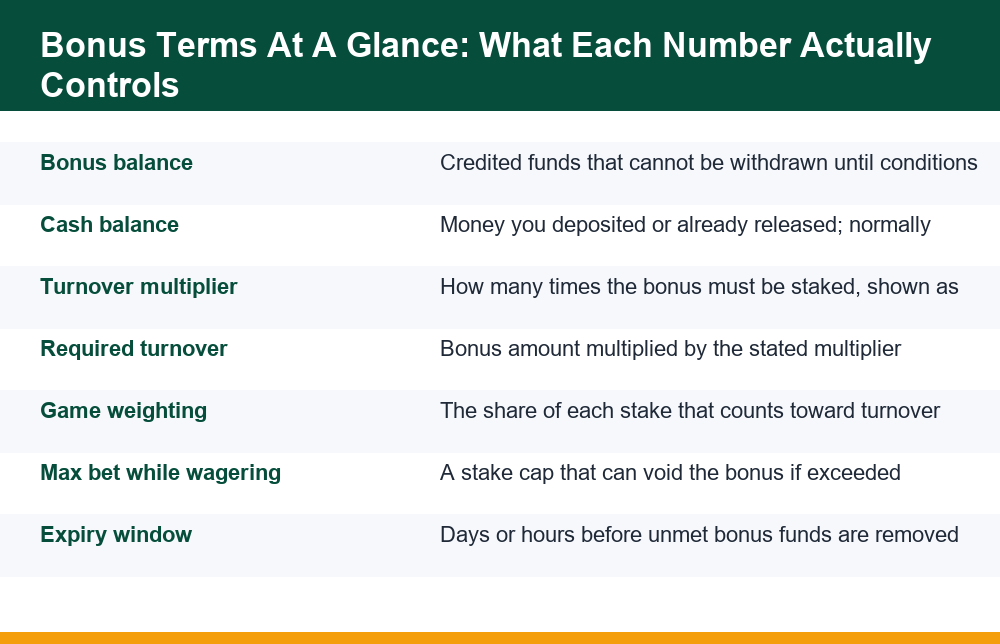
The arithmetic itself is simple. Required turnover equals the bonus amount multiplied by the stated multiplier. A ₹100 bonus at 20x requires ₹2,000 of total staking. The complication is never the multiplication — it is what the multiplier is applied to, and only the written terms settle that.
Three bases are common. Bonus-only means the multiplier applies to the credited amount alone. Deposit plus bonus means it applies to both added together, which doubles the work when the two are equal. Winnings-based means the condition is calculated against whatever the bonus produced. The same “20x” label can mean three materially different amounts of staking depending on which base is in force, so the number on the banner tells you almost nothing on its own.
| Credit | Stated condition | Base used | Turnover actually required |
|---|---|---|---|
| ₹100 bonus | 20x | Bonus only | ₹2,000 |
| ₹100 bonus on ₹100 deposit | 20x | Deposit + bonus | ₹4,000 |
| ₹500 bonus | 10x | Bonus only | ₹5,000 |
| ₹500 bonus | 40x | Bonus only | ₹20,000 |
| ₹50 bonus | 30x | Winnings from bonus | 30x whatever it generated |
Progress against that figure is normally tracked server-side and shown, if at all, on the bonus detail screen as an amount staked against an amount required. Two details are worth checking on that screen. First, whether the number shown is raw stakes or weighted stakes, because the two can differ by a wide margin. Second, whether cancelled, voided or refunded stakes have been removed again, which is common and can make a progress bar appear to move backwards.
Put next to a typical deposit size, the right-hand column of the table is the part worth sitting with. A ₹500 credit at 40x asks for ₹20,000 of staking. Every one of those stakes is exposed to the house margin, and the margin does not pause for promotions. The expected cost of generating that turnover frequently exceeds the face value of the credit, which is the single most useful thing the wagering requirement meaning tells you: a bonus is not free money, it is a discount on an activity with negative expected value.
Credits that arrive through invite links work the same way and are governed by the same conditions, even though they feel more like a reward than an offer. The mechanics of those schemes are set out separately in the breakdown of how referral and invite credit schemes are structured in India.
Why Your Bonus Balance Will Not Withdraw
When a withdrawal request is rejected or silently capped while the wallet still shows a healthy figure, there are a small number of likely explanations, and they are almost always visible in the account itself rather than hidden.
- Turnover is incomplete. The staking total has not yet reached the required figure, so the bonus bucket is still locked.
- Only part of each stake counted. Game weighting reduced the contribution, so your real progress is lower than your stake total suggests.
- A max-bet rule was breached. Many terms cap the stake size allowed while a bonus is active; exceeding it can void the bonus and its winnings outright.
- The bonus expired. Unmet credits are typically removed after a stated window, and winnings tied to them may go with it.
- A maximum cashout applies. Some credits cap the amount releasable regardless of how much the bonus generated.
- Account verification is outstanding. This blocks payouts generally, not just bonus funds, and is a separate issue from turnover.
Working out which one applies is mostly a reading exercise. Open the bonus detail screen and note the required figure and the progress figure; open the written terms for that specific credit and note the base and the contribution rates; then compare your own staking history against both. If progress has stopped advancing entirely while you are still staking, weighting or an exclusion is the usual explanation. If progress vanished, an expiry or a voided credit is more likely.
The distinction that matters for your own troubleshooting is between a condition and a fault. A condition is working as written — unpleasant, but documented. A fault is a payout that will not move despite a cash balance, a completed condition and verified details. Conditions are resolved by reading the terms, and nothing in the app will change them. Faults belong in a support ticket with a transaction reference, a timestamp and a screenshot, because those three items are what let someone trace a single payment rather than reply with a generic answer.
One more honest note: a locked bonus is not evidence of theft, and chasing turnover to “unlock” a credit is how a modest loss becomes a large one. If a credit is locked behind more staking than you intended to do, the straightforward response is to leave it locked and withdraw the cash portion.
Where An App’s Bonus Terms Are Actually Written
Terms are rarely hidden, but they are often placed where nobody scrolls. Knowing the four or five standard locations turns a ten-minute hunt into a thirty-second check, and the whole wagering requirement meaning becomes concrete the moment you read the actual numbers instead of guessing them.
- The offer card itself. Tap the banner or promo tile rather than the accept button; most expand into full conditions.
- A “Terms” or “Rules” link in the promotions tab. Usually small, usually at the bottom of the list.
- The wallet or bonus detail screen. Often shows live turnover progress — staked so far against required.
- Account settings, under help or policy pages. The long-form document lives here.
- The confirmation prompt when accepting a credit. Frequently contains the multiplier in one line of grey text.
- Email or in-app notification that announced the credit. Worth keeping as a record of what was stated.
Four figures are the ones to extract, and they fit in a single note on your phone: the multiplier, the base it applies to, the contribution rate for whatever you actually intend to play, and the expiry. Everything else in a promotional document is context. If those four are present and consistent, you can calculate the real requirement in seconds. If any of the four is missing, the requirement cannot be calculated at all, and no amount of reading further will fix that.
Take a screenshot of whatever you find before you accept anything. Promotional terms change without announcement, and a dated screenshot is the only version of the conditions that cannot be edited after the fact. It is also what makes a support conversation short, because you can quote the figure you were shown rather than argue about what it said.
If an app offers credits but publishes no readable conditions anywhere — no multiplier, no base, no expiry — treat that absence as the most informative fact available. A platform that will not state the condition in writing has already told you how a disagreement about it will go.
Seven Small Terms That Quietly Change The Maths
The multiplier gets the attention, but it is usually not the term that decides the outcome. These are the clauses that do the real work, and each one can turn a credit that looks generous into one that is effectively unreachable.
Game weighting and contribution percentages
A stake rarely counts at full value. Terms commonly assign each category a contribution rate, so a ₹100 stake might count ₹100 toward turnover in one category and ₹10 in another. At 10% contribution, a ₹2,000 requirement needs ₹20,000 of staking. This single clause changes the real requirement by an order of magnitude and is the most frequent reason progress bars crawl. Fast-cycling formats are the ones most often down-weighted — a category explained in the overview of how colour prediction style formats are structured.
Maximum stake while a bonus is active
Often a flat cap. Placing a single larger stake can void the bonus and any winnings from it, with no warning at the moment it happens. This is the clause that produces the angriest complaints, because the breach and the consequence are separated by hours.
Expiry windows
Credits typically carry a validity period measured in hours or days. When it lapses, unmet bonus funds are removed, and in many cases winnings attributable to them are removed as well. A short window combined with a high multiplier is, in practice, a condition structured not to be met.
Maximum cashout caps
Some terms limit the total releasable amount to a multiple of the credit — a cap of 5x on a ₹100 bonus means ₹500 is the ceiling regardless of what the balance reached. Everything above the cap is forfeited at withdrawal.
Sticky versus non-sticky credits
A non-sticky bonus sits beside your cash and is only drawn on once cash is spent, so you can usually withdraw cash at any point. A sticky bonus merges with the balance and locks the whole thing until conditions clear. Which type you have decides whether your own deposit is still reachable.
Excluded payment methods and one-per-account rules
Some deposit routes are excluded from eligibility, and duplicate-account or shared-device rules can void credits retroactively. Neither is visible on the offer banner, and both are typically enforced at withdrawal rather than at the moment the credit is accepted.
Terms that reserve the right to amend
Most promotional documents include a clause allowing the operator to change or withdraw an offer. That is precisely why the dated screenshot matters more than the current version of the page.
Read together, these seven clauses explain why two credits advertised with the same multiplier can be wildly different propositions. Weighting and the base set the size of the task; the maximum stake and the expiry set how fast it can be attempted; the cashout cap sets the most it can ever be worth; and sticky treatment sets how much of your own money is tied up while it runs. The multiplier alone describes none of that.
Checklist Before You Accept Any Bonus Credit
Accepting a credit is a decision, not a gift collection, and once accepted it frequently cannot be declined. Running through six questions first takes under a minute and is the entire practical payoff of understanding the wagering requirement meaning.
- What is the multiplier, and what is it applied to — bonus only, deposit plus bonus, or winnings?
- What is the resulting turnover figure in rupees? Do the multiplication before you accept, not after.
- What contribution rate applies to the formats you actually intend to play?
- What is the maximum stake permitted while the credit is active, and what happens if it is exceeded?
- When does it expire, and is that window realistic against the turnover figure?
- Is there a maximum cashout, and does accepting this credit lock the cash I already hold?
If any of the six has no answer you can find in writing, the safer treatment is to decline the credit and keep your balance in the cash bucket where it stays withdrawable. A credit you cannot evaluate is a liability dressed as a benefit.
It is also worth asking the blunter question underneath all six: do you want to place that volume of stakes at all? If the honest answer is no, then the credit has no value to you at any multiplier, and the sensible move is to ignore it. Free, non-commercial organisations publish plain-language material on setting limits and on recognising when play has stopped being a choice — GamCare’s free safer gambling information pages are one such source.
Mistakes That Cost People Their Balance
The errors below come up repeatedly in user complaints, and all of them are avoidable with information available before the fact rather than after.
- Reading the wallet total as the withdrawable total. Find the split first; the headline figure is a sum, not a promise.
- Assuming turnover means net loss. Turnover counts stakes placed, so the figure moves faster or slower than people expect, depending entirely on weighting.
- Accepting a credit to “see what happens”. Acceptance usually cannot be reversed, and a sticky credit can lock your own deposit alongside it.
- Increasing stake size to finish the turnover faster. This is the classic way to breach a max-bet clause and void everything in one tap.
- Treating a locked bonus as a debt owed to you. Chasing it converts a documented condition into a real loss.
- Not screenshotting the terms. Without a dated record, a support conversation becomes a disagreement about memory.
- Confusing a condition with a technical fault. Escalating a turnover condition to support wastes the time you would need for an actual payout problem.
The through-line is the same in every case. A wagering condition is arithmetic plus fine print, and both halves are knowable in advance. The moment you can state the multiplier, the base, the contribution rate and the expiry for a credit sitting in your account, the mystery disappears — you may still dislike the answer, but you will not be surprised by it, and you will know whether the balance on your screen is money or a label.
Keep the final framing honest, because it is what the terms themselves imply. Conditions are structured so that the staking they require costs, on average, more than the credit is worth. No sequence of stakes changes that margin. Understanding the wagering requirement meaning is useful mainly as a defence — it tells you what you are being offered, and usually tells you to leave it alone.
Frequently Asked Questions
What does wagering requirement mean in simple terms?
It means a credited bonus must be staked a set number of times before it, or the winnings from it, can be withdrawn. A ₹100 bonus at 20x requires ₹2,000 of total stakes. Turnover counts the value of stakes placed, not money won or lost, so the balance can barely move while the requirement is being worked through. Until the figure is reached, the bonus sits in a separate bucket that the payout system will not release.
Why can’t I withdraw my bonus balance?
Usually because the turnover condition is incomplete, because game weighting meant only part of each stake counted, because a maximum-stake rule was breached and voided the credit, because the bonus expired, or because a maximum cashout cap applies. Account verification being outstanding blocks payouts separately. Check the bonus detail screen for live turnover progress, then compare it against the written multiplier and base before contacting support.
What is the difference between wallet balance and withdrawable balance?
Wallet balance is the total the app displays, which normally adds your cash funds, your bonus funds and any locked winnings together. Withdrawable balance is only the portion the payment system will actually release — generally your deposits and already-released funds. The gap between the two figures is the amount still sitting under conditions. It is not a fee or an error, and most apps let you see the split in the wallet detail or transaction history.
What does 20x turnover mean on a bonus?
It means the relevant amount must be staked twenty times over. The critical detail is which amount: bonus only, deposit plus bonus, or winnings. A ₹100 bonus at 20x on bonus only needs ₹2,000 of stakes; the same 20x on deposit plus bonus with a matching ₹100 deposit needs ₹4,000. Game weighting can then multiply the real staking needed again, so always read the base and the contribution rate alongside the multiplier.
Do bonus winnings have withdrawal conditions?
Frequently, yes. Winnings generated while a bonus is active are often held in a locked bucket until the turnover condition clears, and some terms apply a maximum cashout that caps how much can be released regardless of the amount reached. Breaching a maximum-stake rule or letting the credit expire can remove those winnings along with the bonus. The written terms for that specific credit are the only place the treatment is defined.
Where can I find an app’s bonus terms and conditions?
Tap the offer card itself rather than the accept button, then check the Terms or Rules link in the promotions tab, the wallet or bonus detail screen for live turnover progress, the policy pages under account settings, and the confirmation prompt shown when the credit is accepted. The announcement email or in-app notification is also worth keeping. Screenshot whatever you find and note the date, since promotional terms can be amended without notice. Knowing the wagering requirement meaning only helps once you have read the actual figures.
