What is Colour Prediction Game – How It Actually Works
A colour prediction game is a type of online wagering format in which a user selects a colour — typically Green, Red, or Violet — before a countdown timer expires, and receives a payout if the round result matches their selection. The result of every round is determined by a server-side Random Number Generator.
That is the complete technical definition. Everything else — the interface, the referral system, the promotional content, the timing — is built around that core mechanic.
This guide explains every component of colour prediction game mechanics in precise, educational detail. It covers what happens technically from the moment a user places a prediction to the moment a result is displayed, how payouts are calculated, what the house edge means mathematically, and how the four main game formats within the colour prediction category differ from each other.
No platform is promoted. No participation is encouraged. The goal is complete technical understanding.
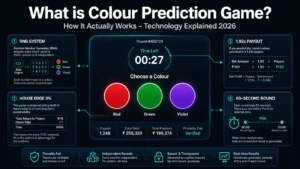
The Core Mechanic — Step by Step – colour prediction game
Understanding what is colour prediction game at a technical level requires following a single round from start to finish.
Step 1 — Round Opens
A new round begins when the previous one closes. The round has a fixed duration — 60 seconds in the most common WinGo format, 3 minutes in some K3 formats. A visible countdown timer shows the time remaining in the round.
Step 2 — User Places Prediction
During the active round, the user selects their prediction — a colour (Green, Red, or Violet in WinGo), a number (0–9), a size (Big or Small), or a combination. The user also enters the amount they wish to wager on that prediction.
Step 3 — Prediction Locks
Approximately 5–10 seconds before the countdown reaches zero, predictions lock. No new bets are accepted. This prevents any possibility of a user seeing the result before placing their bet — which would be the only scenario in which prediction could be non-random from a user perspective.
Step 4 — RNG Generates Result
At the moment the countdown expires, the platform’s server-side RNG generates the round result. This calculation happens entirely on the platform’s servers — it is not performed on any user’s device. The result is a number between 0 and 9 in WinGo, which then maps to a colour (0=Violet, 1/3/5/7/9=Green, 2/4/6/8=Red in the standard WinGo mapping).
Step 5 — Result Displayed
The generated result is transmitted from the server to all connected users simultaneously and displayed on screen. The result appears identical to all users at the same moment.
Step 6 — Payout Calculated and Settled
The platform’s payout engine compares each user’s prediction against the result. Matching predictions receive the applicable payout. Non-matching predictions lose the wagered amount. Settlements are processed automatically and instantly reflected in user balances.
Step 7 — Next Round Begins
The cycle repeats immediately. In 60-second WinGo, a new round opens the moment the previous one closes — creating a continuous, uninterrupted sequence of rounds with no natural stopping point.
The Four Main Colour Prediction Game Formats
Format 1 — WinGo (Colour + Number)
WinGo is the most widely used colour prediction format in India. It is the format most users mean when they ask what is colour prediction game.
Mechanics:
- Round duration: 60 seconds (standard) — some platforms offer 3-minute and 5-minute variants
- Result: A single digit from 0 to 9, generated by RNG
- Number mapping to colour: 0 = Violet | 1, 3, 5, 7, 9 = Green | 2, 4, 6, 8 = Red
- Users can predict: Colour only | Number only | Size (Big = 5–9, Small = 0–4) | Combinations
Payout structure:
| Prediction Type | Payout | Probability | House Edge |
| Colour — Green | 2× | 5/10 = 50% | ~4% |
| Colour — Red | 2× | 4/10 = 40% | ~20% effective |
| Colour — Violet | 4.5× | 1/10 = 10% | ~55% effective |
| Number (specific) | 9× | 1/10 = 10% | ~10% |
| Size — Big/Small | 2× | 5/10 = 50% | ~4% |
Note on Red vs Green probability: Red has only 4 possible outcomes (2, 4, 6, 8) versus Green’s 5 (1, 3, 5, 7, 9) because 0 maps to Violet. This creates a structural imbalance — Red prediction carries higher house edge than Green despite both paying at 2×. Most users are not aware of this asymmetry.
Format 2 — K3 (Three Dice Lottery)
K3 is a draw-based format using three virtual dice. Each die produces a result of 1–6, giving a combined total of 3–18.
Mechanics:
- Round duration: 3 minutes (standard)
- Result: Three dice values summed (range: 3–18)
- Users can predict: Sum total | Big (11–17) or Small (3–10) | Odd or Even | Specific dice combinations
Payout structure varies by prediction specificity — sum predictions for rare totals (3 or 18) pay significantly higher multiples (up to 207×) while Big/Small predictions pay approximately 2×.
House edge: Consistent across prediction types at approximately 4% of all aggregate wagering.
Format 3 — 5D (Five Digit Lottery)
5D is a five-digit draw format where each position produces a digit from 0 to 9 independently.
Mechanics:
- Round duration: 3–5 minutes (varies by platform)
- Result: Five independent digits (e.g., 3-7-1-4-9)
- Users can predict: Individual digit position | Sum of all five | Size of individual positions | Specific combinations
5D offers the widest prediction variety within the colour prediction category — users can focus on a single digit position or predict across multiple positions simultaneously with multiplied payout potential.
Format 4 — Aviator (Crash Format)
Aviator is technically a crash game rather than a colour prediction game — but it appears on the same platforms and within the same app interface, so it warrants inclusion here.
Mechanics:
- A multiplier begins at 1× and increases continuously
- The multiplier can “crash” at any point — determined by RNG
- Users must cash out before the crash occurs to receive the multiplier at cash-out
- If the crash happens before cash-out, the entire wager is lost
Key difference from colour prediction: Aviator involves a user decision during the round — when to cash out — which creates a feeling of greater agency. The outcome is still RNG-determined (the crash point is set before the round begins). The decision of when to cash out does not influence the crash point — only whether the user captures value before it.
House edge: Aviator typically operates at approximately 3–5% house edge, similar to standard colour prediction formats.
How Payouts Are Calculated for Colour Prediction Game
The payout calculation on any colour prediction game follows a consistent formula:
Payout = Wager Amount × Payout Multiplier × (1 – Platform Fee)
On most platforms, the platform fee is embedded in the payout multiplier rather than deducted separately. A 2× payout on a 50/50 outcome already incorporates the house edge — the mathematically fair payout for a true 50/50 outcome would be 2× with no fee retained.
Example — WinGo Green prediction:
- Wager: ₹100
- True probability of Green: 50% (5 outcomes out of 10)
- Mathematically fair payout at true odds: ₹200 (2×)
- Actual payout: ₹192 (1.92×)
- Platform retention: ₹8 (4% of ₹200 fair value)
Over 100 rounds of ₹100 wagers (₹10,000 total wagered):
- Expected wins at 50% probability: 50 rounds
- Expected total payout: 50 × ₹192 = ₹9,600
- Expected net loss: ₹400 (4% of ₹10,000)
This is not a worst-case scenario — it is the mathematical expectation. Individual sessions can and do produce net wins. But the 4% retention is applied to every single wager regardless of individual outcomes, making it a statistical certainty that aggregate user losses exceed aggregate user winnings over time.
What the Results Board Shows — and What It Does Not
Every colour prediction platform displays a results history board — showing the outcomes of recent rounds, typically the last 10–50 results. Users study this board intensively, looking for patterns, streaks, and sequences they believe predict upcoming outcomes.
This practice is based on a fundamental misunderstanding of how RNG works.
What the results board shows:
A record of past RNG outputs — statistically independent events with no mathematical relationship to each other.
What the results board does not show:
Any information about future results. A streak of ten consecutive Green results does not make the eleventh result more or less likely to be Green or Red. The probability of every outcome is identical before every single round, regardless of all previous results.
The results board exists because users want to see it — and because displaying it increases engagement time. It is not a predictive tool. It is a historical record of random events that the human brain naturally — and incorrectly — interprets as pattern-bearing sequences.
How Colour Prediction Differs From Skill Gaming
The distinction between colour prediction and skill gaming is not just a legal technicality — it has practical implications for every user.
| Dimension | Colour Prediction | Skill Gaming (e.g., Rummy, Fantasy Sports) |
| Outcome determination | RNG — server-side random | Player ability — knowledge, strategy, speed |
| Effect of practice | Zero — RNG outputs cannot be learned | Significant — skill improvement increases win rate |
| Effect of strategy | Zero — no strategy influences RNG | Significant — better strategy improves outcomes |
| Legal classification | Chance-based — gambling regulations apply | Skill-based — exempt from gambling prohibitions in most states |
| House edge mechanism | Payout multiplier below fair odds | Entry fee percentage from prize pool |
| Long-term profitability | Mathematically unlikely for most users | Possible for skilled players |
Frequently Asked Questions – what is colour prediction game?
Q1. What is a colour prediction game?
A colour prediction game is an online wagering format where users predict a colour or number outcome before a countdown timer expires. Results are generated by a server-side Random Number Generator. The most common format is WinGo — a 60-second round where users predict Green, Red, or Violet. Payouts are applied automatically based on whether the prediction matches the RNG-generated result.
Q2. How is the result of a colour prediction round determined?
Every round result is generated by a Random Number Generator (RNG) on the platform’s server. The RNG produces a statistically independent, unpredictable output for each round. The result is calculated after predictions lock — meaning no user has any information advantage. No external tool, signal, or strategy can predict RNG outputs.
Q3. What is the house edge in colour prediction games?
The house edge is the percentage of all aggregate wagering retained by the platform regardless of individual outcomes. On standard WinGo colour prediction, the house edge is approximately 4% — embedded in the 1.92× payout structure rather than charged as a separate fee. This means users collectively lose approximately 4% of all money wagered over time.
Q4. What is the difference between WinGo, K3, and 5D formats?
WinGo is a 60-second colour and number prediction format using a single digit (0–9). K3 is a three-dice draw format with 3-minute rounds producing a combined total of 3–18. 5D is a five-digit independent draw format with variable prediction options across all five positions. All three formats use RNG for result generation and operate on a similar house-edge model.
Q5. Can you predict colour prediction game results using patterns from the results board?
No. The results board shows a history of statistically independent RNG outputs. Past results have zero mathematical relationship to future results. The belief that past results predict future ones is called the gambler’s fallacy — a well-documented cognitive bias. No pattern analysis, signal group, algorithm, or tool can produce reliable predictions of RNG outputs.
Q6. What is Aviator game and how does it differ from WinGo?
Aviator is a crash game format where a multiplier increases from 1× until it crashes — with the crash point determined by RNG before the round begins. Users must cash out before the crash. Unlike WinGo’s passive prediction, Aviator involves a real-time cash-out decision — creating greater perceived agency. However, the crash point is RNG-determined and cannot be predicted. The house edge is similar to WinGo at approximately 3–5%.
Q7. Why does Red prediction have a higher house edge than Green in WinGo?
In standard WinGo, digits 0–9 map as follows: 0 = Violet, 1/3/5/7/9 = Green, 2/4/6/8 = Red. Red has only 4 possible outcomes versus Green’s 5 — giving Red a true probability of 40% versus Green’s 50%. Both pay at 2× (1.92× after fee). This means Red carries a structurally higher effective house edge than Green despite identical payout rates. Most users are not informed of this asymmetry.
Q8. Is colour prediction game legal in India?
Legality depends on state and platform registration status. Colour prediction is classified as a chance-based game — it does not qualify for the skill-game legal exemption. It is specifically prohibited in Tamil Nadu, Telangana, and Andhra Pradesh. No colour prediction platform currently operating in India is registered under the Online Gaming Act, 2025. Users in all states should understand their specific state’s legal position before participating.
This content is for educational and informational purposes only. We do not promote or endorse any gaming platform. No affiliate links are present. Nothing here constitutes financial, legal, or investment advice.
