India has more than 700 million smartphone users and one of the fastest-growing digital economies in the world. Within that landscape, online earning apps have become one of the most searched, most downloaded, and most discussed categories of mobile software — spanning everything from skill-based gaming and prediction platforms to task completion, referral programmes, cashback systems, and freelance marketplaces.
Most users install earning apps before fully understanding how they work. This guide changes that. It is a purely educational resource that explains the technology, economics, and mechanics behind every major type of earning app operating in India — not to promote any of them, but to give users the complete picture before they decide whether and how to engage with them.
Understanding how an earning app actually generates revenue — and where user earnings come from within that model — is the most important piece of information any user can have. This guide provides it clearly and honestly for every major app category in India.
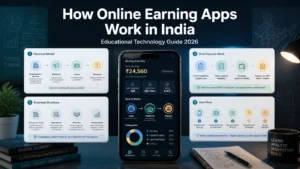
How Online Earning Apps Work in India
What Is an Online Earning App?
An online earning app is any mobile or web-based application that offers users money, rewards, or credits in exchange for some form of participation — whether that is placing predictions, completing tasks, referring other users, playing skill-based games, completing surveys, or making purchases through cashback systems.
The category is broad. The mechanics differ significantly across types. What they share is a digital interface, Indian user focus, UPI-based payment integration, and a business model that funds user payouts from somewhere within its revenue structure.
That last point — where the money comes from — is the question this guide is specifically designed to answer for each category.
Category 1 — Prediction-Based Earning Apps
How They Work
Prediction-based apps — the largest and most discussed category in India — ask users to predict an outcome before each round. The most common format is colour prediction: choose Green, Red, or Violet before a 60-second timer expires. Other formats include number prediction, dice prediction (K3), and multi-digit prediction (5D).
The result of each round is generated by a Random Number Generator (RNG) — a computational algorithm that produces statistically independent, unpredictable outputs. No external tool, signal, or strategy can predict RNG outputs. Each round is entirely independent of all previous rounds.
The Business Model
The financial engine of every prediction app is the house edge — a percentage of all aggregate wagering retained by the platform regardless of individual round outcomes.
On standard WinGo colour prediction:
- A correct prediction pays 1.92× the wagered amount
- The mathematically fair payout for a 50/50 outcome would be 2.0×
- The difference — 0.08×, or approximately 4% — is retained by the platform on every wager
This means that for every ₹100 wagered collectively by all users on a platform, the platform retains approximately ₹4 regardless of who wins or loses individual rounds. Over millions of daily wagers, this creates substantial platform revenue that is mathematically guaranteed regardless of individual user outcomes.
Where user earnings come from: User winnings are funded by other users’ losses. The platform is a financial intermediary that retains 4% of all money moving through it. Some users win in individual sessions. In aggregate, users as a group lose approximately 4% of all money wagered over time.
Key Technology Components
- RNG engine — server-side result generation, inaccessible to users
- Timer system — synchronised round countdown across all users
- Payout calculator — automatic win/loss settlement per round
- UPI integration — deposit and withdrawal processing
- Referral tracking system — commission attribution per referred user activity
Category 2 — Referral-Based Earning Apps
How They Work
Referral-based earning apps pay users a commission for recruiting new users to the platform. When the recruited user deposits and plays, the referring user earns a percentage of that activity — either as a flat fee per registration or as an ongoing percentage of the referred user’s wagering activity.
The Business Model
Referral commissions are funded directly from the platform’s house-edge revenue. The platform retains 4% of all wagering. A portion of that retention is redistributed to referring users as commission. The referred user’s losses — built into the house edge — ultimately fund both the platform’s profit and the referrer’s commission.
Referral model types in India:
| Model | Structure | Sustainability |
| Flat fee per registration | Fixed amount (e.g., ₹150) per new signup | Limited — pays once regardless of referred user activity |
| Activity commission | % of referred user’s ongoing deposits | Ongoing — but depends on referred user continuing to play |
| Multi-level commission | Commission from referrals of referrals | Pyramid structure — sustainability concerns |
Where user earnings come from: Referral income is funded by the referred users’ net losses through the house edge. The referring user earns because the referred user loses. This is the direct economic relationship — not always made explicit in promotional content.
Key Technology Components
- Unique referral code/link generation per user
- Attribution tracking — connecting new registrations to referring users
- Commission calculation engine — real-time or batch commission processing
- Multi-level tracking — for platforms with two or three-tier referral structures
Category 3 — Skill-Based Gaming Apps
How They Work
Skill-based gaming apps — including WinZo, MPL, and similar platforms — offer games where the outcome is primarily determined by the player’s ability, knowledge, speed, or strategy. Formats include fantasy sports, card games (rummy), puzzle games, trivia, and casual competitive games.
The legal distinction between skill-based and chance-based gaming is fundamental in Indian law. The Supreme Court of India has consistently held that games where skill is the predominant factor are not gambling and fall outside gambling prohibitions.
The Business Model
Skill-based platforms earn revenue through:
- Entry fees — users pay to enter a game or tournament; the platform retains a percentage of the prize pool (typically 15–20%)
- Advertising revenue — display advertising within the app
- Premium subscriptions — access to advanced features or exclusive tournaments
Where user earnings come from: On skill platforms, better players earn from weaker players within the same competitive pool. The platform takes its percentage from the prize pool. Unlike prediction apps, skill improvement genuinely increases earning probability over time.
Key Technology Components
- Matchmaking algorithm — pairing players of similar skill levels
- Anti-cheat systems — detecting automation and cheating attempts
- Real-time multiplayer infrastructure — low-latency game synchronisation
- Skill rating systems — tracking and updating player ability scores
Category 4 — Task-Based and Survey Apps
How They Work
Task-based apps pay users to complete defined micro-tasks — watching videos, rating apps, completing surveys, testing products, or verifying data. Survey apps specifically connect Indian users with market research companies that pay for consumer opinion data.
The Business Model
Task and survey apps act as intermediaries between businesses needing data or micro-task completion and users willing to provide that labour. The platform earns a margin on every task it distributes — paying users less than it charges the business commissioning the task.
Where user earnings come from: Task earnings are funded directly by the businesses commissioning tasks. This is the most transparent earning model in the category — user earnings are genuinely funded by external business payments, not by other users’ losses.
Indian task apps include: Google Opinion Rewards, Swagbucks India, TaskBucks, RozDhan (mixed model — tasks and referrals).
Key Technology Components
- Task distribution engine — matching users to available tasks based on profile
- Verification system — confirming task completion before payment
- Survey routing — matching survey demographics to user profiles
Category 5 — Cashback and Affiliate Apps
How They Work
Cashback apps pay users a percentage of their purchase value when they shop through the app’s affiliate links. The app earns an affiliate commission from the retailer for directing traffic and sales. A portion of this commission is passed to the user as cashback.
The Business Model
The retailer pays the cashback app a commission (typically 2–15% of sale value depending on category) for attributing the sale. The app keeps a portion and passes the remainder to the user as cashback.
Indian cashback apps include: CashKaro, GoPaisa, Meesho (partial cashback model).
Where user earnings come from: Cashback earnings are funded by retailer affiliate commissions — genuinely external revenue. This is another transparent model where the user is not funding other users’ earnings.
Category 6 — Freelance and Gig Apps
How They Work
Freelance and gig apps connect Indian workers with businesses or individuals needing services — content writing, graphic design, delivery, home services, data entry, and similar work. Users earn by completing paid work for clients.
Indian platforms include: Fiverr (global), Freelancer, Urban Company (home services), Rapido (delivery), Swiggy/Zomato (food delivery gig workers).
The Business Model
The platform charges a service fee or commission — typically 10–20% of the transaction value — from either the worker, the client, or both. User earnings are funded directly by client payments.
Where user earnings come from: Client payments minus platform commission. This is the most straightforward earning model — users exchange their time and skills for direct compensation.
The Most Important Question — Is the Earning Sustainable?
Every earning app category above has a different answer to this question.
| Category | Earning Source | Sustainable? | Skill-Dependent? |
| Prediction apps | Other users’ losses (house edge) | No — house edge works against all users in aggregate | No — RNG outcomes cannot be influenced |
| Referral apps | Referred users’ losses | Limited — requires constant new recruitment | No — dependent on others’ behaviour |
| Skill-based gaming | Weaker players in same pool | Possible — for genuinely skilled users | Yes — skill improvement increases earning |
| Task/survey apps | Business commissions | Yes — while tasks are available | Minimal — consistency matters |
| Cashback apps | Retailer affiliate commissions | Yes — while shopping through the app | No — automatic on qualifying purchases |
| Freelance/gig apps | Direct client payments | Yes — while work is available | Yes — skills directly determine earnings |
The table above is the most important information on this page. It shows that prediction and referral apps are the only categories where user earnings are funded by other users’ financial losses — making them structurally different from every other earning app type.
Technology Infrastructure Behind Earning Apps
Understanding the technical components behind earning apps helps explain both how they function and where vulnerabilities exist.
Server-side processing:
All financially critical operations in legitimate earning apps — result generation, payout calculation, balance management — are processed on the app’s servers, not on the user’s device. This means no modification to the local app can affect outcomes. Claims about “hack APKs” that alter results are technically impossible — the result is never calculated on the user’s device.
UPI payment integration:
Indian earning apps use UPI through payment gateway integrations — typically Razorpay, Cashfree, or PayU — to process deposits and withdrawals. UPI transactions are settled through the NPCI infrastructure. This means deposit and withdrawal failures are either gateway failures or deliberate platform decisions — not UPI system failures.
KYC and identity verification:
Regulated platforms implement Aadhaar-linked KYC at registration or before first withdrawal. Unregistered platforms often skip upfront KYC — creating faster onboarding but also less identity protection for users and reduced accountability for the platform.
Data handling:
Every earning app collects significant user data — mobile numbers, transaction history, device identifiers, behavioural patterns. Under India’s Digital Personal Data Protection Act, 2023, this data must be handled under clearly stated purposes with user consent. Compliance with this Act on unregistered platforms is not verifiable.
Legal Framework for Earning Apps in India — 2026
The legal position of earning apps in India in 2026 is determined primarily by the type of app and the state in which it is used.
Online Gaming Act, 2025:
Establishes a formal registration framework for online gaming intermediaries. Registered platforms must meet standards covering fair play, RNG auditing, responsible gaming, financial transparency, and user grievance redressal. Most prediction apps operating in India are not registered under this framework.
Public Gambling Act, 1867:
India’s foundational gambling legislation — predating the internet by over a century. Applies to chance-based gaming. Most legal analyses consider colour prediction apps to fall within its scope despite the Act’s pre-digital framing.
IT Act, 2000:
Governs digital transactions and cyber activities. Provides the broader legal infrastructure within which earning apps operate.
Income Tax — Section 194BA:
Gaming winnings above ₹10,000 per transaction are subject to TDS under Section 194BA of the Income Tax Act. This obligation applies regardless of the platform’s registration status.
State-level variations:
Tamil Nadu, Telangana, and Andhra Pradesh have enacted specific legislation prohibiting online gambling including prediction apps. Users in these states face direct legal exposure.
Frequently Asked Questions – How Online Earning Apps Work in India
Q1. How do online earning apps actually make money?
Earning apps generate revenue through different models depending on type: prediction apps retain approximately 4% of all wagering through the house edge; skill-gaming apps charge entry fee percentages from prize pools; task apps charge businesses for task distribution; cashback apps earn affiliate commissions from retailers; freelance apps charge service fees on transactions. The revenue model determines where user earnings ultimately come from.
Q2. Is it possible to earn consistently from prediction apps?
No earning app can guarantee consistent income, but prediction apps are specifically structured so that consistent earnings are mathematically unlikely. The house edge means the platform retains approximately 4% of all aggregate wagering. Individual sessions can produce wins. Sustained consistent profitability across all users is mathematically impossible — some users win, but users in aggregate lose more than they win over time.
Q3. What is the difference between skill-based and chance-based earning apps?
Skill-based apps produce outcomes primarily determined by player ability — improving your skills genuinely improves your earning probability over time. Chance-based apps (prediction, lottery) produce RNG-determined outcomes — no amount of practice, strategy, or knowledge can meaningfully influence results. Indian law treats these two categories fundamentally differently — skill-based apps are legal in most states; chance-based apps face significant regulatory restrictions.
Q4. How does a referral earning model work?
When you recruit a new user to a platform using your referral link, you earn a commission based on that user’s subsequent activity — either a flat fee per registration or an ongoing percentage of their deposits. This commission is funded from the platform’s house-edge revenue. The direct economic relationship is: the referred user loses money through the house edge; a portion of that loss funds your referral commission.
Q5. Are earning app withdrawals processed through UPI reliably?
UPI itself is a highly reliable payment infrastructure operated by NPCI. Withdrawal delays or failures on earning apps are almost never caused by UPI system failures — they are caused either by payment gateway issues (technical) or deliberate platform decisions to delay or refuse withdrawals (operational). Distinguishing between these two causes requires contacting the platform’s support channel and your UPI provider.
Q6. What is the Online Gaming Act, 2025 and how does it affect earning apps?
The Online Gaming Act, 2025 establishes a formal registration framework requiring online gaming intermediaries to join a Self-Regulatory Organisation (SRO) and meet defined compliance standards. Registered platforms must provide fair play verification, responsible gaming tools, financial transparency, and user grievance mechanisms. Most prediction and lottery earning apps operating in India are not registered under this framework — meaning users of these platforms have none of the protections the Act is designed to provide.
Q7. Do I need to pay tax on earning app income in India?
Yes. Gaming winnings above ₹10,000 per transaction are subject to TDS under Section 194BA of the Income Tax Act — regardless of whether the platform is registered or not. All other earning app income — referral commissions, task earnings, cashback — is taxable as income under applicable Indian tax law. Consult a qualified tax professional for guidance on your specific situation.
Q8. How do I know if an earning app is legitimate?
Check for: Google Play Store listing, verifiable MCA21 company registration (mca.gov.in), transparent withdrawal terms, accessible privacy policy, responsible gaming provisions, and independent withdrawal complaint history. Platforms registered under the Online Gaming Act, 2025 meet formal compliance standards. Unregistered APK-only platforms operate without any of these accountability mechanisms.
Q9. What is an RNG and why does it matter for prediction apps?
A Random Number Generator is a computational algorithm that produces statistically independent, unpredictable numerical sequences. In prediction apps, the RNG determines every round result on the platform’s server — before bets are placed and before results are displayed. This means no external tool, signal, pattern analysis, or strategy can predict or influence results. Any person or product claiming otherwise is making a technically impossible claim.
Q10. What should I do if an earning app refuses my withdrawal?
First, review the platform’s withdrawal terms to confirm you have met all requirements. Contact the platform’s official support channel and document all communication. If the platform demands a new deposit to release existing funds, stop immediately — this is a manipulation tactic. Report unresolved withdrawal issues to your UPI provider and to the National Cyber Crime Reporting Portal at cybercrime.gov.in. In states where online gambling is prohibited, you may also report to local police.
This content is for educational and informational purposes only. We do not promote or endorse any earning or gaming platform. No affiliate links are present. Nothing here constitutes financial, legal, or investment advice.